
In December 2025, Portugal published two legal acts in its official gazette: Law No. 69/2025 and Law No. 70/2025, both dated 1 December. These laws ensure the implementation of Regulation (EU) 2023/1114 (MiCA) and Regulation (EU) 2023/1113 (the TFR).
Now, Portugal has officially aligned its AML regime with the European standards applicable to transfers of funds and crypto assets, as well as with FATF’s recommendations.
Going forward, crypto asset service providers (CASPs) and entities seeking to offer digital assets to the public or admit them to trading on platforms can apply for authorisation from the relevant local authorities. Moreover, entities licensed in other Member States can now operate freely within Portugal.
What is the scope of the Travel Rule in Portugal?
The Portuguese regulators adhered to the requirements of the TFR, including the changes made in Article 38, which update the existing EU anti-money laundering rules under the Fifth AML Directive.
In other words, the Portuguese Travel Rule will apply to the “transfers of funds, in any currency, or crypto assets, which are sent or received by a payment service provider, a crypto-asset service provider, or an intermediary service provider (brokers and custodians) established in the European Union.” [TFR Chapter I, Article 1]
Who is the supervisory body for CASPs in Portugal?
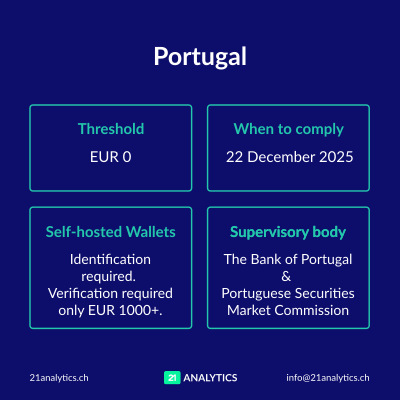
The Bank of Portugal (Banco de Portugal - BdP) is responsible for supervising:
- Titles III (asset-referenced tokens) and IV (e-money tokens) of MiCA;
- Chapters 1, 4 and 5 of Title V;
- Articles 67, 68, 73 and 74.
The Portuguese Securities Market Commission (Comissão do Mercado de Valores Mobiliários - CMVM) is responsible for overseeing:
- Title II and Title VI;
- Chapter 3 of Title V;
- Articles 66, 70, 71, and 72.
What is the Travel Rule threshold in Portugal?
EUR 0
The Travel Rule applies to all transactions irrespective of value.
Originator CASPs must communicate the following information with each crypto transfer before or simultaneously with the transfer:
- originator's name,
- originator's distributed ledger address,
- originator's crypto asset account number,
- originator's address, which must include the name of the country, official personal document number and customer identification number, or alternatively, date and place of birth,
- originator's LEI (where applicable, or an equivalent official identifier).
- beneficiary's name,
- beneficiary's distributed ledger address,
- beneficiary's crypto asset account number,
- beneficiary's LEI (where applicable, or an equivalent official identifier).
Does the Portuguese Travel Rule apply to self-hosted wallets?
Transfers involving a self-hosted wallet and a CASP fall under the scope of the Travel Rule.
To ensure compliance, the originator’s CASP must obtain and hold the necessary Travel Rule data and ensure the transfer can be individually identified.
Additionally, for transactions of EUR 1000 and up, a proof of self-hosted wallet ownership must be requested. [TFR Chapter III, Section 1, Article 1(5)]
Moreover, per Article 19(a), Member States are required to assess and identify the risks associated with transfers involving self-hosted wallets; accordingly, CASPs must implement risk-appropriate controls.
These controls should include one or more of the following measures:
(a) applying a risk-based approach to identify and verify the identity of the sender or recipient of a transfer involving a self-hosted wallet, or their beneficial owner, including where this information is obtained from third parties;
(b) requesting additional details about the source and destination of the crypto assets being transferred;
(c) carrying out enhanced and ongoing monitoring of these transactions; and
(d) adopting any other measures needed to reduce and manage money-laundering and terrorist-financing risks, as well as the risk of breaching or circumventing targeted financial and proliferation-related sanctions.
Become Travel Rule Compliant with 21 Analytics
When do you need to comply with the Travel Rule in Portugal?
Now. The Travel Rule is in effect.
However, MiCA includes a transition period for VASPs already registered with the Bank of Portugal, allowing them to continue operating while they apply for full MiCA authorisation. These firms have until 1 July 2026 to obtain a licence.