
Taiwan has formally amended its existing anti-money laundering (AML) framework for virtual asset service providers (VASPs) to introduce updated Travel Rule requirements, aligning its approach with the Financial Action Task Force (FATF) Recommendation 16.
On 4 August 2026, Taiwan's Financial Supervisory Commission (FSC) announced draft amendments to its Regulations Governing Anti-Money Laundering and Countering the Financing of Terrorism for Enterprises or Persons Providing Virtual Asset Services. Following the consultation process, the FSC formally published amendments to Articles 7, 14 and 18 on 20 October 2026.
The amended framework introduces a threshold-enhanced information collection mechanism. VASPs must collect and securely transmit basic originator and beneficiary information regardless of transaction value. Transfers exceeding NT$30,000 are subject to additional information requirements and beneficiary verification obligations.
The FSC is pursuing a phased implementation approach, initially prioritising transfers between domestic VASPs before extending the framework to international transfers. The final implementation scope and timetable are to be determined by the Taiwan Virtual Asset Service Provider Association, subject to FSC approval.
What is the scope of the Travel Rule in Taiwan?
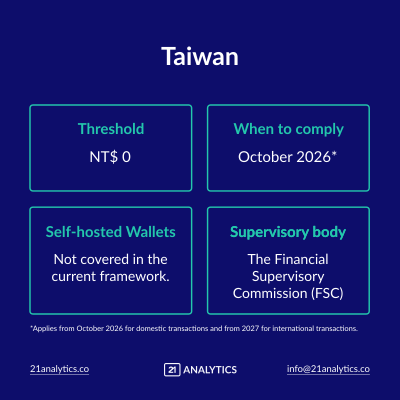
Under amended Article 7 of Taiwan's VASP AML/CFT regulations, the Travel Rule applies to covered virtual asset transfers regardless of transaction value.
The FSC's implementation approach prioritises transfers between domestic VASPs. The framework is intended to extend to transfers involving overseas VASPs, with the international implementation schedule subject to the VASP association's arrangements and FSC approval.
Who is the supervisory body for VASPs in Taiwan?
The Financial Supervisory Commission (FSC)
What is the Travel Rule threshold in Taiwan?
NT$ 0
VASPs must obtain the originator's and beneficiary's names and the wallet information used to transfer and receive the virtual assets.
However, for transfers exceeding NT$ 30 000, additional information must be collected depending on whether the parties are individuals or legal entities.
Obligations of originator virtual asset service providers
Under amended Article 7, VASPs acting as the originating party must obtain the necessary and accurate information about the originator and the necessary information about the beneficiary.
For all covered transfers, the required information includes:
- The originator's name or legal entity name.
- The beneficiary's name or legal entity name.
- The wallet information used to transfer and receive the virtual assets.
For transfers exceeding NT$ 30 000, additional information must be obtained:
- When the originator is a natural person, their date of birth and residential address.
- When the originator is a legal entity, their official identification number and registered address, along with the company’s registration.
- When the beneficiary is a natural person, their country and city of residence.
- When the beneficiary is a legal entity, their official identification number and the name of the country and city where it is registered.
The originating VASP must transmit the required information to the receiving VASP immediately and securely.
Where a VASP cannot fulfil the information collection and transmission requirements, it must not execute the virtual asset transfer.
The amendments also require VASPs to confirm that the supervisory regulations applicable to their counterparties are consistent with the AML/CFT standards established by the FATF.
Obligations of beneficiary virtual asset service providers
Beneficiary VASPs have an active role in receiving and checking Travel Rule information.
Under the amended regulations, receiving VASPs must take appropriate measures to identify virtual asset transfers that lack the required originator and beneficiary information.
For transfers exceeding NT$ 30 000, the receiving VASP must compare the information it holds against the beneficiary's name and receiving wallet information supplied by the originating VASP.
Where missing information or discrepancies are identified, the receiving VASP must apply risk-based policies and procedures to determine whether the transfer should be executed, refused or suspended. Appropriate follow-up measures must also be taken.
Does Taiwan's Travel Rule apply to self-hosted wallets?
The FSC's initial implementation approach focuses on transfers between domestic VASPs, with international VASP-to-VASP transfers planned as a subsequent phase.
Currently, the framework does not provide clear requirements for transactions involving self-hosted wallets.
However, this should not be interpreted as a general exemption for self-hosted wallet transactions from AML/CFT controls. VASPs remain subject to applicable customer due diligence, transaction monitoring and risk-based requirements.
The treatment of transfers involving self-hosted wallets should therefore be assessed against the wider AML/CFT framework and any subsequent FSC guidance.
When do you need to comply with Taiwan's Travel Rule?
20 October 2026 for domestic transactions.
- The FSC announced its draft amendments on 4 August 2026.
- On 20 October 2026, the FSC formally published amendments to Articles 7, 14 and 18 of the VASP AML/CFT regulations.
The FSC's initial implementation approach prioritises domestic VASP-to-VASP transfers. The international phase is intended to extend the requirements to transfers involving overseas VASPs.
VASPs should monitor the association's approved implementation timetable and further regulatory announcements.
Become Travel Rule Compliant with 21 Analytics
Which regulations are applicable to Taiwan's Travel Rule?
Amendments to Articles 7, 14 and 18, published 20 October 2026
Money Laundering Control Act and Counter-Terrorism Financing Act
What else do you need to know about the Travel Rule in Taiwan?
Taiwan's Virtual Asset Service Act
Taiwan's Legislative Yuan passed the Virtual Asset Service Act on 30 June 2026. The Act was subsequently promulgated on 22 July 2026 but has not yet entered into force.
The legislation introduces a broader regulatory framework for VASPs, moving beyond AML registration towards a formal licensing and supervisory regime. It also establishes requirements governing stablecoin issuance, custody, governance and operational controls.
The FSC has indicated that the Act and its nine subordinate regulations are expected to take effect together, potentially from the first quarter of 2027. The final commencement date is to be determined by the Executive Yuan.
Importantly, the Travel Rule amendments are being introduced under Taiwan's existing AML/CFT framework and are separate from the future commencement of the Virtual Asset Service Act.