
2027’s Top Crypto Trends and Travel Rule Predictions
After several years of regulatory development, major financial markets have established frameworks governing digital assets, stablecoins and virtual asset service providers (VASPs). Taken together, these developments indicate that the focus in 2027 is likely to shift towards the practical implementation, supervision and enforcement of existing regulatory frameworks
In the European Union, the Markets in Crypto-Assets Regulation (MiCA) is moving into its next phase of application and supervisory oversight. In the United States, the GENIUS Act is progressing towards implementation, establishing a federal framework for payment stablecoins. Meanwhile, the United Kingdom is preparing to bring its new crypto asset regulatory regime into effect on 25 October 2027.
Against this backdrop, 2027 is likely to bring greater institutional participation, more consistent AML/CFT expectations and increased scrutiny of cross-border transactions.
Here are 21 Analytics’ predictions* for the regulatory and technological developments likely to shape the cryptocurrency industry in 2027.
Stricter Crypto Regulation Enforcement
After years of developing and introducing regulatory frameworks, many jurisdictions are now entering the phase of ensuring that crypto businesses implement these requirements effectively and comply with them in practice.
The European Union provides a clear example. MiCA established a harmonised framework for crypto asset service providers (CASPs), introducing requirements covering authorisation, governance, custody, market integrity and consumer protection. Following the end of the transitional arrangements on 1 July 2026, supervisory authorities will increasingly assess how effectively firms meet these obligations.
Moreover, the European Securities and Markets Authority (ESMA) has emphasised the importance of consistent supervisory expectations and orderly transitions to MiCA authorisation.
The United Kingdom is following a similar trajectory. The FCA’s new crypto asset regulatory regime is scheduled to take effect on 25 October 2027, bringing activities such as operating trading platforms, safeguarding crypto assets and issuing qualifying stablecoins within the financial services regulatory perimeter.
In the United States, implementation of the GENIUS Act will also become a major focus. The Office of the Comptroller of the Currency (OCC) issued final regulations for payment stablecoin issuers under its jurisdiction in October 2026, with the rules taking effect on 18 January 2027.
Global Travel Rule Enforcement will Increase
Although FATF Travel Rule adoption has progressed, implementation remains uneven. In its July 2026 Seventh Targeted Update on Implementation of the FATF Standards on Virtual Assets/VASPs, the FATF reported that 83% of surveyed jurisdictions had passed legislation implementing the Travel Rule, compared with 73% in 2025. A further 11 jurisdictions reported that implementation was underway.
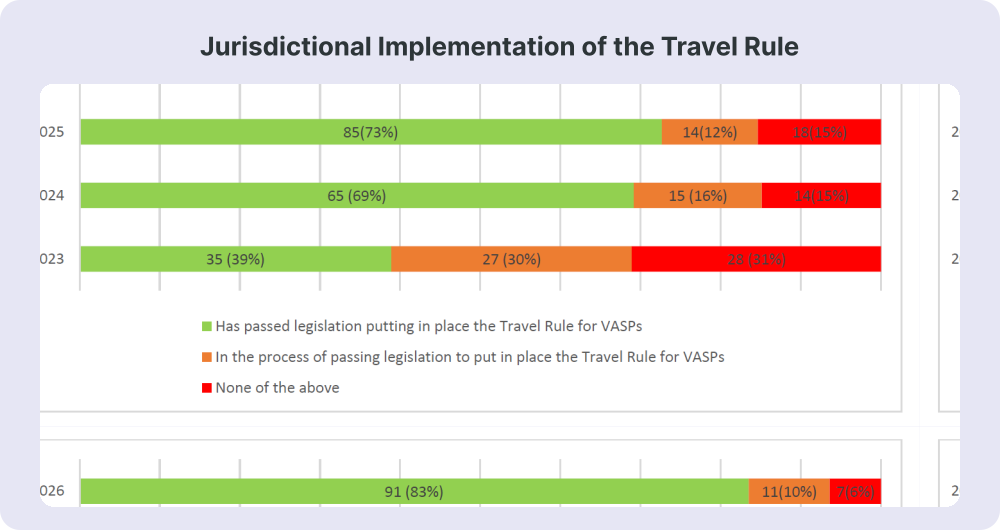
However, legislative adoption does not necessarily translate into effective operational compliance. Differences in national requirements, technical standards, enforcement capabilities and counterparty connectivity continue to create challenges for international transfers.
In October 2026, the FATF announced a targeted review process to accelerate implementation of its virtual asset standards. Initial results are expected in June 2027, with further results scheduled for October 2027.
According to the FATF’s 2026 findings;
- VASPs will need reliable ways to exchange Travel Rule information with counterparties operating under different regulatory frameworks (cross-border) and technical standards,
- regulators will continue to scrutinise transfers involving self-hosted wallets, including the identification and verification of wallet ownership where required, and
- identifying the receiving VASP, assessing its regulatory status and establishing secure communication channels will remain important parts of compliance programmes.
Stablecoin Regulation Will Accelerate Institutional Adoption
This topic was greatly discussed in 2026. The 21 Team witnessed this first hand at the various conferences they attended throughout the year. Stablecoins are becoming an important component of digital financial infrastructure. Their potential applications extend beyond cryptocurrency trading to include payments, remittances, settlement and international transfers.
This growth is attracting greater attention from financial institutions and regulators.
The United States' GENIUS Act represents an important step towards establishing a federal regulatory framework for payment stablecoins. Its implementation will introduce requirements relating to permitted issuance, reserve assets, redemption, custody, risk management and supervision.
The OCC's October 2026 final rule provides further detail on how these requirements will apply to issuers under its jurisdiction.
In the European Union, stablecoin issuers are already subject to MiCA requirements, including specific provisions governing asset-referenced tokens and e-money tokens.
Read: Stablecoins in the EU: What Has Changed?
Stablecoins intended for mainstream financial use will increasingly be expected to operate within established prudential, governance and AML/CFT frameworks.
In 2027, this could accelerate participation from traditional financial institutions, payment providers and other regulated entities.
AI Usage for Compliance Automation Will Increase
As regulatory expectations expand and transaction volumes grow, manual compliance processes will become difficult to maintain.
VASPs must manage several interconnected responsibilities, including customer due diligence, transaction monitoring, Travel Rule information exchange, counterparty verification and regulatory reporting.
These processes often involve multiple systems, blockchain networks and external service providers.
In 2027, automation and artificial intelligence are likely to play a growing role in helping compliance teams manage this complexity.
Technology architecture will also remain an important consideration. Businesses handling sensitive customer information must assess where that information is stored, how it is transferred and which parties can access it.
For regulated institutions, compliance technology must support both operational efficiency and the security and integrity of sensitive information.
Solutions that provide secure, reliable and interoperable data exchange will become increasingly important as the digital asset ecosystem expands.
How 21 Travel Rule Supports Compliance Automation
21 Travel Rule helps VASPs automate key aspects of their Travel Rule compliance workflows through secure, peer-to-peer information exchange via TRUST and TRP. Its automation capabilities reduce the need for manual intervention when managing counterparty communications and transaction information.
As an on-premises solution, 21 Travel Rule also allows organisations to retain control over sensitive customer information within their own infrastructure, rather than relying on a third-party hosted solution. This enables VASPs to improve operational efficiency while maintaining control over data security, privacy and compliance processes.
Read: What Are the Regulatory Benefits of an On-premises Solution?
The Year the Industry Operationalises Compliance
The ecosystem’s next phase will be defined less by the introduction of entirely new regulatory concepts and more by the practical application of existing frameworks.
MiCA supervision, the UK's forthcoming crypto asset regime and the implementation of US stablecoin legislation illustrate how major financial markets are moving towards more established regulatory oversight.
At the same time, FATF's findings demonstrate that significant gaps remain between legislative adoption and effective implementation, particularly in relation to the Travel Rule and international cooperation.
For VASPs, these developments can be translated into a list of priorities, which include strengthening AML/CFT controls, improving counterparty due diligence, supporting cross-border information exchange and investing in compliance infrastructure that can adapt to different regulatory requirements.
For the industry, 2027 could be the year in which regulatory readiness became an operational requirement rather than simply a strategic objective.
*This article reflects 21 Analytics’ predictions and opinions on potential industry developments in 2027. These are not guarantees of future outcomes and should not be considered financial, investment or legal advice.
Disclaimer
This material is provided for educational and informational purposes only and is not intended to be a substitute for professional advice or detailed research.


